
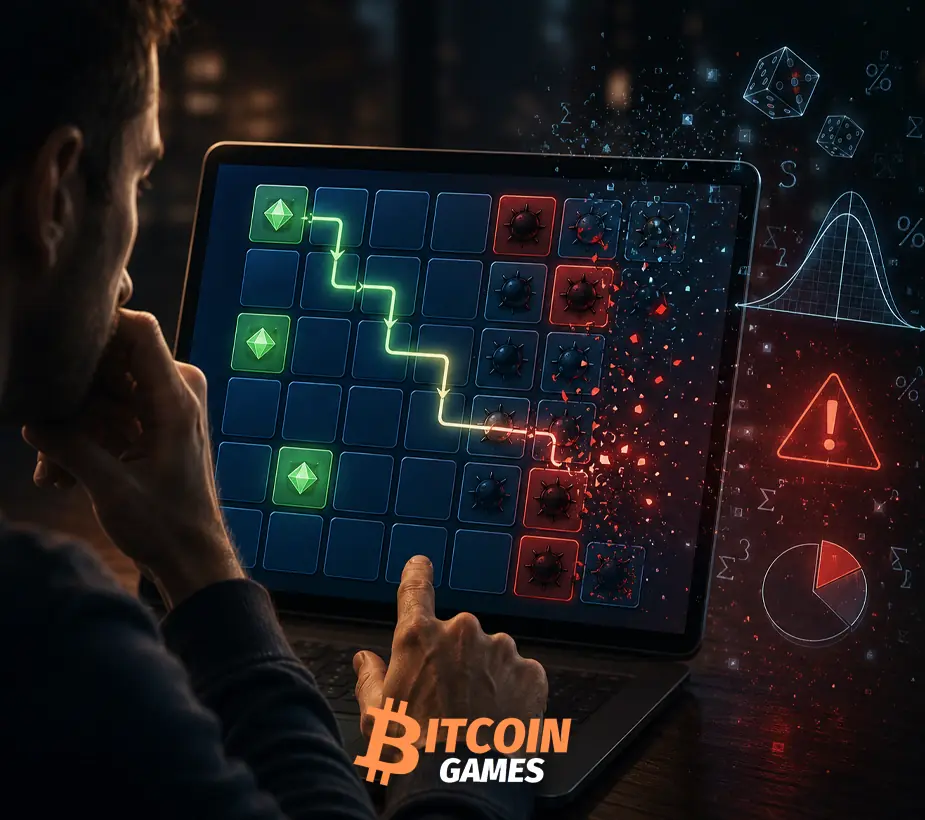
The Mines game has become one of the most recognizable instant casino style games because it is simple, fast, and easy to understand. A player sees a grid, chooses tiles, avoids hidden mines, and decides whether to continue or cash out. That simplicity is a major part of the appeal. It creates a game that feels strategic, because every click looks like a decision. The more tiles you reveal, the more tension builds. The more mines you avoid, the more the payout can grow.
However, that same simplicity also creates one of the biggest misunderstandings around the game. Many players believe there are safe paths, hidden patterns, favorable routes, or repeatable tile sequences that can reduce the chance of hitting a mine. Some players try to memorize previous rounds. Others follow diagonal paths, corners, center tiles, checkerboard layouts, or repeated movement patterns. The idea is attractive because it makes the game feel less random and more controllable.
The reality is very different. In a properly designed Mines game, there is no universal safe path. The position of mines should be determined randomly or through a provably fair system, depending on the platform. That means each round needs to be treated as its own independent risk event. A path that worked before does not become safer because it succeeded. A tile that avoided a mine in the previous round does not become lucky. A corner does not become safer than the center simply because it feels more defensive.
This article explains the difference between myth and reality in the Mines game. It looks at why safe path theories are so common, why random outcomes make fixed routes unreliable, how risk changes with mine count and tile selection, and how players can approach the game with a more realistic mindset. The goal is not to make Mines risk free. That is impossible. The goal is to understand the mechanics clearly enough to avoid false confidence.
At its core, Mines is a probability based casino game. The player selects tiles on a hidden grid. Some tiles are safe, and some contain mines. Each safe tile revealed usually increases the possible payout, while selecting a mine ends the round and loses the active stake. The player can usually choose how many mines are placed on the board, which directly changes the level of risk and reward.
The game feels interactive because the player chooses each tile. That interaction matters for the experience, but it does not necessarily mean the player can detect where the mines are. Unless a game is poorly designed or compromised, the player should not have visual clues that reveal safe tiles. The grid is not a puzzle in the traditional sense. It is a risk selection interface.
Mines feels strategic because every choice is visible. A slot spin happens all at once, but a Mines round unfolds step by step. Each click creates suspense, and each successful tile makes the player feel more involved. That pacing can make the brain interpret success as skill, even when the underlying result is governed by probability.
This does not mean there is no decision making. There is. The player decides the number of mines, the stake, how many tiles to reveal, and when to cash out. Those are real strategic decisions. But choosing the exact tile is not the same kind of decision if the board is random. The strategy is mainly in risk control, not in discovering a secret path.
The safe paths myth is the belief that certain tile routes are more likely to avoid mines. These routes can take many forms. Some players believe corners are safer. Others believe the center is safer. Some prefer diagonal movement, edge movement, or symmetrical patterns. There are also players who believe that repeating a path that recently worked gives them a better chance of success.
The problem is that these theories usually come from observation without statistical proof. A player may survive several rounds using the same pattern and conclude that the pattern has value. In reality, short term success can happen by chance. A path can work multiple times and still have no predictive power. Random outcomes often create patterns after the fact, but those patterns do not necessarily help predict the future.
People are naturally good at detecting patterns. That ability is useful in many areas of life, but it can be misleading in gambling games. When random outcomes produce a streak, the brain often tries to explain it. If a diagonal path wins three times, it starts to feel meaningful. If a corner tile hits a mine twice, it starts to feel dangerous. These impressions can become personal rules even when they are not supported by the game mechanics.
This is one reason Mines can be psychologically powerful. The player is not just watching randomness. The player is participating in it. That participation makes the result feel personal, and personal results are easier to overinterpret.
In a fair Mines game, the board outcome should not depend on the shape of your path. If the mine positions are generated randomly before or during the round according to the game rules, every unrevealed tile carries risk based on the remaining number of mines and unrevealed tiles. The risk changes mathematically as the round progresses, but it does not change because a tile is in a corner, on an edge, or in the middle.
For example, if a grid contains hidden mines and you have no information about their positions, a tile does not become safer because it is visually separated from the last tile you clicked. The board design can make some paths feel cleaner or more controlled, but the visual arrangement does not create protection by itself.
One of the most important realities is independence. A previous round does not tell you where mines will be in the next round. If you used a specific route and won, that route does not become safer next time. If you hit a mine on the first click, that does not mean the next round owes you a safer start. The game does not have memory in the way players often imagine.
This is where many myths become dangerous. Players may believe that a cold path should turn hot, or that a previously successful path is worth repeating. Both ideas can lead to overconfidence. The correct approach is to treat each new round as a fresh probability event.
Although safe paths are a myth, risk is not fixed. Several real factors change the risk profile of a Mines session. The most important are the number of mines selected, the size of the stake, the number of tiles revealed, and the cash out point. These factors matter much more than the visual route used on the grid.
The number of mines is one of the biggest risk controls in the game. Fewer mines usually means a higher chance of revealing safe tiles, but lower payout growth. More mines usually means higher payout potential, but a much greater chance of ending the round quickly. This is a real decision, and it should be matched to the players bankroll and risk tolerance.
Every additional safe tile can increase the potential payout, but it also requires accepting another risk. Many players lose because they survive several clicks and then keep going without a clear reason. They are not following a plan. They are reacting to momentum. In Mines, knowing when to stop is often more important than choosing where to click.
Stake size changes how much pressure each decision carries. A player using too large a stake may become emotional quickly, especially after a mine hit. Smaller stakes can create more room for controlled play, while oversized stakes can turn normal variance into panic. The game is already risky. The stake should not make it emotionally unmanageable.
One common belief is that corner tiles are safer than other areas of the grid. This idea probably comes from visual psychology. Corners feel more contained. They appear less surrounded by danger. In traditional puzzle games, corners can sometimes have special meaning. In Mines, however, a corner is just another tile unless the game rules specifically make it different, which standard Mines style games do not.
If mine placement is random, corners do not have built in protection. A corner can be safe or dangerous in the same way any other hidden tile can be safe or dangerous. Choosing corners may make a player feel organized, but it should not be mistaken for a mathematical edge.
Diagonal paths are another popular theory. They feel smooth, deliberate, and structured. Some players believe diagonal movement avoids clusters or reduces the chance of hitting a mine. Again, the problem is that the pattern is visual, not informational. A diagonal route does not reveal hidden data about where mines are placed.
If a diagonal path succeeds, that success is not proof that diagonals are safer. It only means the selected tiles happened to be safe in that round. The same path could fail immediately in another round. A clean looking route is not the same as a safer route.
Some players track previous boards and look for repetition. They may believe that mines avoid the same region twice, that certain tiles become safer after being dangerous, or that the game rotates risk around the grid. These ideas can feel logical, but they usually misunderstand randomness.
In a fair independent game, previous results do not create reliable future predictions. A tile that had a mine last round can have a mine again. A tile that was safe several times can become dangerous next. Random does not mean evenly spread in the short term. It means outcomes are not following a player readable pattern.
Many crypto casino versions of Mines use provably fair systems. These systems are designed to let players verify that outcomes were not manipulated after the fact. This can be valuable because it gives transparency around fairness. However, provably fair does not mean predictable. It does not mean the player can know the safe path before playing.
A provably fair system is about verifying integrity, not creating a strategy map. It can help confirm that the result was generated according to a transparent method, but it does not turn Mines into a solvable puzzle. Players sometimes confuse fairness with control. A fair random game can still be highly risky.
A realistic Mines strategy starts by abandoning the idea of guaranteed safe paths. The player should focus on controllable decisions instead. That means choosing a mine count that fits the session, setting a stake that does not create pressure, deciding a reasonable cash out point, and accepting that every click carries risk.
One useful habit is deciding in advance how many successful tiles are enough. This prevents emotional extension. Without a target, players often keep clicking because the round feels good. That is exactly when risk can become underestimated. A preset exit point helps keep the session disciplined.
New players should usually begin with lower risk configurations. This helps them understand the pace of the game without exposing too much bankroll too quickly. Higher mine counts can be exciting, but they can also end rounds very fast. Learning the game with moderate settings creates a better foundation.
One of the worst habits in Mines is trying to recover immediately after a loss. A mine hit can feel personal because the player made the click. That feeling can trigger another quick round, a higher stake, or a riskier mine setup. This is where discipline matters most. A loss does not improve the odds of the next round.
Bankroll management is the most practical form of control in Mines. You cannot control where the mines are, but you can control how much you risk, how long you play, and when you stop. A player with strong bankroll rules is usually in a better position than a player who believes in a secret path but has no limits.
Good bankroll management includes setting a session budget, using stakes that allow enough attempts, avoiding emotional increases, and withdrawing or stopping when the plan says to stop. These rules may sound simple, but they are more useful than any tile pattern theory.
The idea of safe paths in Mines is attractive because it makes the game feel more controllable. Players want to believe that a route, pattern, corner, diagonal, or previous result can reveal where the safe tiles are. In reality, a properly designed Mines game does not work that way. The board should be random, and the real decisions are about risk level, stake size, number of clicks, and cash out discipline.
The myth is that there is a hidden path waiting to be discovered. The reality is that Mines is a probability game where no visual route can guarantee safety. That does not mean players cannot make better decisions. They can. But better decisions come from bankroll control, realistic expectations, disciplined exits, and an understanding of variance. The safest path in Mines is not a pattern across the grid. It is a controlled approach before the first tile is ever clicked.
 en
en  ES
ES FR
FR DE
DE


