
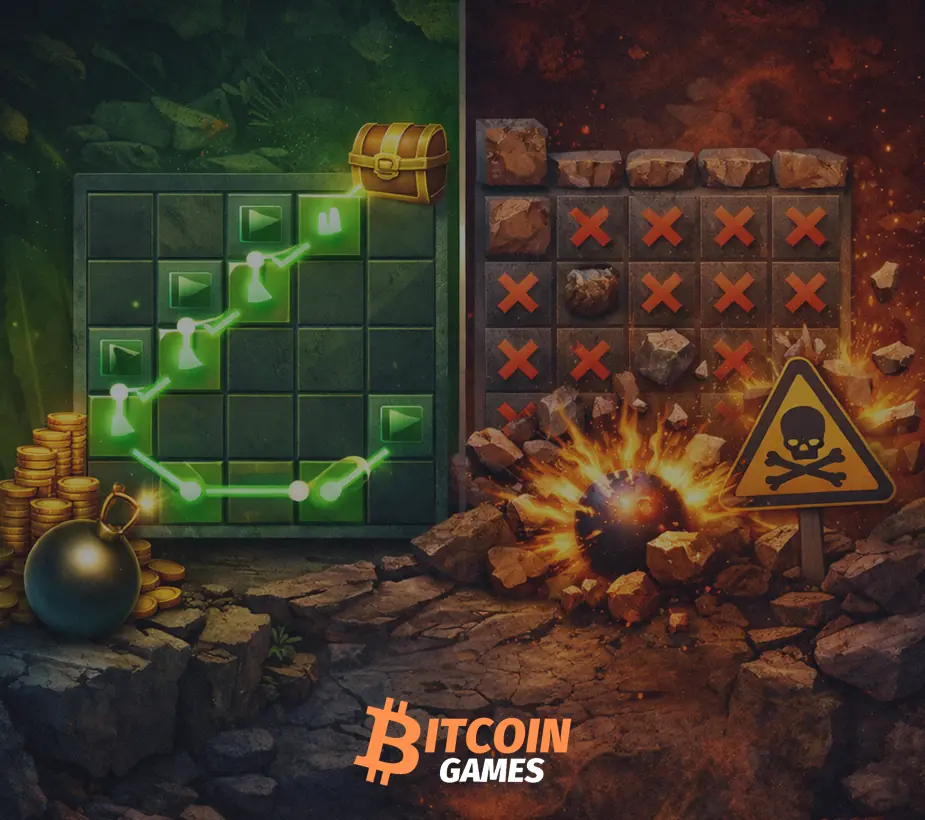
The Mines game has become a flagship mini-game across many online and crypto casinos. Its rules are simple: a grid, a hidden set of mines, and the hope that you can uncover a sequence of safe tiles and cash out before hitting a bomb. Around this simple structure, entire communities have built “safe path” strategies, pattern charts, and so-called guaranteed methods. From a professional standpoint, however, these claims rarely survive basic probability analysis.
This article takes a rigorous look at how Mines actually works under the hood, how random number generators (RNGs) determine outcomes, and why popular “safe path” systems consistently fail over the long run. We also examine risk management, volatility, and practical guidelines so that players can make informed choices instead of relying on myths disguised as strategy.
Although implementations differ slightly between casinos and providers, the core mechanism of Mines is remarkably consistent. At the start of each round, the system randomly selects which tiles will contain mines and which will be safe. You see only the grid and the number of mines; your task is to uncover safe tiles and decide when to cash out.
Reputable operators use a certified random number generator or a provably fair mechanism to determine the placement of mines. The key concept is independence: each round is generated separately, and your previous results do not influence the configuration of the next board. There is no memory, no “streak correction,” and no hidden pattern for players to exploit reliably.
Before each round, you choose your bet amount and, in many versions, the number of mines. More mines mean higher risk but higher potential multipliers for each safe click. Fewer mines provide more frequent small wins but lower growth per tile. The house edge is baked into these multipliers and remains stable regardless of any pattern system you try.
A safe path is typically described as a predetermined route through the grid (for example, always clicking the first column from top to bottom, or moving diagonally). Some communities extend this idea into detailed charts showing supposed hot zones or safe lanes.
Humans are naturally pattern-seeking. After a few sessions where a certain path seems to avoid mines, it is tempting to believe there is something special about that route. Confirmation bias reinforces the illusion: you remember the times it worked and mentally discount the times it failed. Social proof in forums and chat rooms amplifies this effect when multiple users share selective anecdotes of success.
From a probability standpoint, a path is just a sequence of tile selections. If the mines are placed randomly each round, no specific path has a better long-term success rate than any other path, assuming the number of tiles you click is the same. Over many trials, every fixed pattern converges to the same expected value defined by the game’s house edge and parameters.
Professional evaluation of Mines strategies starts by dismantling the most widespread misconceptions that drive poor decision-making.
In a properly implemented RNG system, the mine positions in one round do not influence the next. The game does not “remember” where mines were placed previously. Any perceived avoidance of repetition is simply statistical noise. Over a large sample size, you will see repetitions and clusters that look unusual but are perfectly consistent with randomness.
Claims that mines are more likely to appear in the middle or along the edges lack any mathematical foundation. If the provider distributes mines uniformly, each tile has the same probability of being a mine before the board is generated. Edges, corners, and center tiles all share identical initial risk. Selecting tiles by geometric preference does not alter the underlying odds.
Some strategy sellers claim to have reverse-engineered the algorithm behind Mines. In reality, properly audited RNG or provably fair systems are specifically designed to resist such exploitation. With modern casinos diversifying their mini-games and providers, the notion of a single exploitable weakness that can be consistently abused is not credible and often associated with paid signal groups rather than professional analysis.
To understand why safe paths fail, we need to look at probability and return to player (RTP). RTP represents the long-term percentage of total stakes that will be returned to players. Mines typically has a competitive RTP, but it is still less than 100%, which means the house has a small but persistent edge.
When you choose a number of mines and a bet size, the game’s paytable and multipliers are structured so that the expectation per round is slightly negative for the player. This expectation is independent of which tiles you select. Whether you click tiles in a straight line, random pattern, or “tested” route, the underlying math does not change.
Every additional tile you uncover increases your exposure to risk. Even on a board with few mines, the probability of eventually hitting one rises quickly as you click more tiles. Safe path strategies often encourage multiple clicks per round to “reach the safe zone,” unintentionally increasing the likelihood of a catastrophic loss compared to simply taking smaller profits earlier.
Although you cannot beat Mines through path selection, there are professional ways to optimize your experience, manage risk, and avoid common psychological traps.
Start by defining a bankroll dedicated specifically to mini-games. Break this bankroll into small units (for example, 0.5% to 2% of the session total per round). This prevents a single unlucky board from destroying your entire balance. While it does not change RTP, it stabilizes your variance and allows for longer, more controlled sessions.
Instead of chasing high multipliers with many clicks on a single board, define a maximum number of safe tiles you are willing to uncover before cashing out. For example, you might target two or three successful clicks in low-mine configurations and lock in incremental returns, rather than aiming for deep, risky paths that are more likely to end in a mine.
Players often shift from rational play to emotional chasing after a sequence of losses. Increasing bet size aggressively or trying to “force” a safe path after several bad boards only magnifies variance. Professional discipline means treating each round as statistically independent and ignoring the urge to compensate for past outcomes.
Mines belongs to a wider category of high-tempo mini-games designed around simple mechanics and clear risk–reward trade-offs. Games like crash, plinko, limbo, and similar formats all rely on the same basic structure: transparent multipliers, fast rounds, and mathematically defined RTP.
Serious players often analyze several games side by side, comparing volatility, bet flexibility, and user interface. Some prefer to explore curated lists of mini-games first, using independent overviews such as a structured mini-games catalog to understand how Mines fits into the broader set of options before committing a bankroll strategy.
One of the most important factors in evaluating Mines is not the path strategy but the integrity of the game implementation itself. In the crypto space especially, many serious operators rely on provably fair systems where seed values and hashes allow players to verify that rounds were not manipulated after the fact.
These technical assurances do not change the house edge, but they ensure that you are facing a legitimate, predictable environment rather than opaque manipulation.
The real distinction in Mines is not between safe and unsafe paths, but between safe and unsafe practices. Path selection is essentially cosmetic; what matters is how you manage exposure and expectations over time.
Even with clear evidence that safe paths do not beat the house, myths continue to flourish. Understanding the psychology behind this can help players stay grounded.
Players tend to remember spectacular wins far more vividly than slow, grinding losses. A dramatic run of safe tiles reinforces the belief in a chosen pattern, while the many failed attempts fade into the background. Strategy sellers amplify these rare streaks as marketing material, ignoring the far larger dataset where their systems behave no better than chance.
Choosing tiles manually feels more skillful than spinning a slot reel, even when the underlying math is similar. This illusion of control can be comforting but is dangerous if it leads players to overestimate their ability to influence outcomes that are purely random.
Mines is a fast, engaging mini-game with clear rules and strong visual feedback. Its simplicity, however, has made it a breeding ground for unfounded “safe path” systems that promise more than they can deliver. From a professional perspective, every fixed pattern converges on the same expected value defined by RNG, RTP, and game configuration. No route through the grid can reliably outperform these fundamentals over the long term.
What players can control is not the distribution of mines but their own bankroll structure, session design, and psychological discipline. By prioritizing transparent implementations, realistic expectations, and robust risk management, Mines can remain what it is at its best: a high-tempo game of chance where entertainment value is maximized and misconceptions are kept firmly in check.
 en
en  ES
ES FR
FR DE
DE


